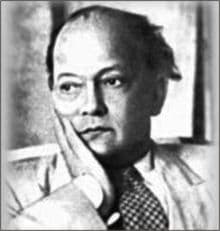
Sayed Mujtaba Ali was an eminent literateur and a distinguished linguist. At the call of Mahatma Gandhi, he left the school and joined the Non-violence Movement. Between 1921 and 26, he studied at Santiniketan. After the completion of his studies at the Visva-Bharati University, he went to Kabul where he was appointed a Lecturer in English and French in the Kabul Education Service. He was awarded a scholarship by the German Govt. Between 1928 and 30, he studied at the University of Berlin and Bonn and obtained his PhD degree. Afterwards, he became an itinerant and travelled across the whole of Europe including Jerusalem and Damascus. After his return in 1936, he was invited to chair the Comparative Religion Dept. at Baroda. In 1950, he joined the All India Radio as its Station Director. He headed the Dept. of Islamic Studies at Santiniketan for a few years. Among his notable publications mention may be made of Dese Bidese, Pancatantra, Cdcdkdhini etc. In 1949, he was awarded the Nara Singha Das Memorial Prize for his outstanding contributions to Bengali literature.
Like him [Sri Ramakrishna] none had ever spoke in such a simple language. His words and the way of talking have their closest similarity with that of Christ. …He was determined to attach greatest value to the folk religion, customs, rituals and language, and, hence, had continually used peoples’ language and the mode of talking with heart’s content.
…If for reasons of spiritual, social or political discord different sects living within the same society refuse to be cohesive among themselves, it results in an irreparable loss to that society as a whole, which may, even, lead to its enormous extinction. How many of the virtuous people in those days [We doubt] were aware of this truth?
…Paramahamsa Deva decided to do away with such discords, so he never avoided the pointless and unpopular discussion centring the Form and the Formless. As a proof of that we frequently see that he was not satisfied with the company of his Hindu disciples and followers alone, and has earnestly kept on asking – where is Vijay [Vijaykrishna Goswami], Sivanath [Sivanath Sastri] has assured me that he would come, Keshub [Keshub Chandra Sen] is very dear to me. But he hardly was willing to convert his Brahmo disciples to Kali-worship. With his entire heart he only yearned that the conflict should disappear. It is my firm belief that for obviating the conflict, Sri Ramakrishna deserves the unique glory.
The sage who could harmonize Gita’s doctrine of Karma, Juana and Bhakti is, as it were, the man absolute – the Supreme man. …Ever since these three ways were introduced in the Gita, no fourth method has yet been discovered. He, who could harmonize these three ways, becomes the companion of Krsna – and his name is Sri Ramakrishna.
Reflections from Readers
1 comment
KALHAN SANYAL
শ্রীরামকৃষ্ণদেব আমার ইষ্ট। সৈয়দ মুজতবা আলী আমার অনাবিল আনন্দ। প্রণাম সাষ্টাঙ্গ প্রণাম।
Comments are closed.
More in Reminiscences
Aldous Huxley
Aldous Huxley was an English writer and one of the most prominent members of the famous Huxley Family. He spent the latter part of his life in United States, living in Los Angeles from 1937 until his death in 1963. He was the author of The Perennial Philosophy. ‘The further you go towards the East,’ Sri Ramakrishna was…
Read
Amaury De Reincourt
Amaury de Reincourt was born in Orleans, France. He received his BA from the Sorboune and his MA from the University of Algiers. He has authored several books. Of these the most remarkable publications are The Soul of India and The American Empire, The Eye of Shiva : Eastern Mysticism and Science. His reading of the Bhagavad-Gita as ‘the…
Read
Amiya Chakravarty
Amiya Chakravarty was one of the greatest critics of the Post Tagorean period, and a well known Poet. He was Rabindranath’s travel companion during his tours to Europe and America in 1930 and to Iran and Iraq in 1932. The Ramakrishna-Vivekananda tradition… was rooted in India’s perennial philosophy. Truth is One; men call it by different names :…
Read